Your cart is currently empty!

New to Propagate Lab: check out our Seltzer Kit containing everything needed to make an award-winning seltzer!
The goal of this section is to provide an overview of how a beer recipe is designed and calculated.
There is a lot that goes into designing an award-winning beer. It is as much an art as it is a science, and there’s more than one way to develop a great recipe. A good place to start is by learning from what other brewers have done.
If you’ve never looked at a beginner brewing text, I highly recommend Designing Great Beers by Ray Daniels. While a bit dated, it still provides an excellent foundation for understanding ingredient selection across beer styles.
Another excellent resource is the thriving community of online brewing forums. The Mad Fermentationist blog offers thoughtful insights into homebrewing and fermentation science. Likewise, Brülosophy provides data-driven experiments and myth-busting brewing tests. You can also find numerous “clone recipes” — attempts to replicate commercial beers. Some brewers, such as Russian River’s Vinnie Cilurzo, have even shared their own clone recipes for homebrewers.
In this module, we’ll approach recipe design by working backward from the information provided by the Beer Judge Certification Program (BJCP) style guidelines. Download the latest 2021 BJCP Style Guidelines (PDF) for a complete reference on beer categories and characteristics.
To begin, we’ll build a simple recipe and calculate how much of each ingredient is needed step by step. While this process might seem tedious at first, it’s important to understand the underlying calculations before relying on software to do them for you.
Our example will focus on a classic American Pale Ale — think Sierra Nevada Pale Ale — to illustrate the principles of recipe design.

The first ingredient we need to determine is the amount of each grain to add.
The combination of all these grains is called the Mash Bill.
Before we can calculate grain amounts, we need to define two key brewing terms:
Plato and Specific Gravity. Both describe sugar concentration
in wort and help us predict the beer’s potential alcohol content.
A scale measuring the concentration of dissolved sugars in wort as a percentage by weight.
Example: 12°P means 12% sugar.
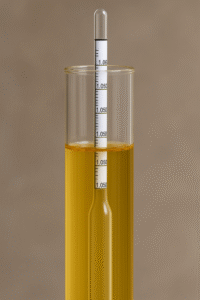
A ratio comparing wort density to water density.
Pure water = 1.000; wort with sugar may read 1.050.
In brewing, Plato and Specific Gravity (SG) are two ways to express the concentration of sugars in wort.
While SG is a ratio comparing the density of wort to water, Plato expresses the percentage of sugar by weight.
Brewers often need to convert between these depending on their tools or measurement preferences.
To convert Specific Gravity to Plato, use this formula:
Example: If SG = 1.050
Plato ≈ (1.050 − 1) × 1000 ÷ 4 = 12.5°P
To convert Plato to Specific Gravity, use this formula:
Example: If Plato = 12°P
SG ≈ 1 + (12 ÷ 250) = 1.048
| Plato (°P) | Specific Gravity (SG) |
|---|---|
| 10 | 1.040 |
| 12 | 1.048 |
| 15 | 1.060 |
| 20 | 1.083 |
Note: These are approximate conversions. For precise brewing, use digital tools or brewing software
that account for temperature correction and wort composition.
 }})
In the last module, we mentioned that 2-Row and 6-Row barley contain different amounts of starch and sugar — but it’s more complex than that.
When you purchase one pound of barley, you’re actually buying a mix of many compounds, not just sugar.
These compounds can be grouped into two main fractions: fermentable and unfermentable.
The ratio between these two fractions can vary, but the diagram above provides a general overview.
Each major fraction contains sub-components.
The unfermentable fraction includes minerals, proteins, gums such as pentosans and glucans, and large starch molecules called dextrins.
The fermentable fraction consists of sugars of various sizes — primarily maltose.
In reality, all of this potential fermentable material starts out as starch and is only converted into sugars during mashing.
 }})
There’s also variation in sugar potential among different malt types.
The table above provides examples.
Malts that contribute color and flavor — such as caramel or chocolate malt — contain less sugar than pale base malts.
This reduction occurs because the sugars are partially transformed into color compounds during the final stages of malting.
The label “Extract, Coarse Grind, Dry Basis” indicates that the malt was ground to a specific size and then soaked in water to test how much sugar it could release.
“Dry basis” means the result is adjusted for moisture content, so you’re measuring extract potential as if the malt were completely dry.
 }})
The graphic above shows this testing process: a pound of malt is milled, soaked in a fixed volume of water at a specific temperature, then filtered and measured for sugar content.
The test can also be done using a fine grind, reported as “Fine Grind, Dry Basis.”
These extract values are listed on every bag of malt and are essential when calculating how much grain to use in a recipe.
 }})
Now that you have a good understanding of malt properties and extract potential, it’s time to look at the equation brewers use to calculate how much malt to add.
Don’t worry — it’s less intimidating than it looks once you break it down.
Brewers need to calculate the amount of malt required to reach their target wort volume, gravity, and brewhouse efficiency.
This formula allows you to do just that by combining all the key brewing parameters that affect extract yield and efficiency.
Malt Amount (lbs) =
(% Malt Used × Wort Volume × Water Weight per Barrel × Specific Gravity × Plato %) ÷
(% Extract (CGDB) × (1 − % Moisture) × Brewhouse Efficiency)
The percentage of a specific malt in your total grain bill. Example: 70% base malt.
The total volume of cooled wort you aim to collect, usually measured in barrels (1 barrel = 31 gallons).
A constant representing water’s weight per barrel: 258.54 lbs (31 gallons × 8.34 lbs/gallon).
For homebrewers, use 8.34 lbs per gallon.
A measure of wort density compared to water. Example: 1.050 indicates sugar-rich wort.
A scale measuring dissolved sugars in wort by weight. 12° Plato = 12% sugar.
The potential yield of fermentable sugars from malt (dry basis).
Typical base malts yield around 80%.
The water content in malt. Higher moisture means less extractable sugar. Typically 3–5%.
How effectively your system extracts sugars from malt.
Most breweries operate around 80% efficiency.
By plugging these values into the formula, you can estimate how much malt you’ll need to reach your brewing target.
Keep in mind that most recipes use multiple grains — for example, 95% pilsner malt and 5% wheat.
🔍 Tip: For hands-on learning, try using the Malt Amount Calculator below this section to test different parameters and see how the values change.
Now that we know how the malt calculation works, let’s return to our example: an American Pale Ale.
We’ll compose a grain bill of:
To perform the calculation, we’ll need to know each malt’s Coarse Grind, Dry Basis (CGDB) and Moisture%,
along with our batch volume and brewhouse efficiency. These values can be found on malt specification sheets from the supplier.
For this example, we’ll use data from Briess Malt:
| Malt Type | Percentage | CGDB (%) | Moisture (%) | Weight (lbs) |
|---|---|---|---|---|
| Briess Brewer’s Malt | 90% | 80.0% | 3% | 486.9 |
| Briess Caramel Vienna 20L | 5% | 79.0% | 3% | 85.8 |
| Briess Heritage Gold | 5% | 80.5% | 3% | 84.2 |
| Total | 100% | — | 656.9 lbs | |
Batch Parameters:
10 BBL batch of American Pale Ale • OG: 1.050 (≈12.4°P) • 80% brewhouse efficiency • Briess CGDB values
Formula: Malt (lbs) = (% Malt × Wort Volume × 258 × SG × Plato %) ÷ (CGDB × (1 - Moisture) × Efficiency) Example – Briess Brewer’s Malt: = (0.90 × 10 × 258 × 1.050 × 12.4) ÷ (0.800 × 0.97 × 0.80) = 3023.16 ÷ 0.6208 = 486.9 lbs Repeat for each malt: Caramel Vienna 20L = 85.8 lbs Heritage Gold = 84.2 lbs Total Malt Bill = 656.9 lbs
And there you have it! You can now calculate the grain bill for any recipe — whether it uses one malt or many — as long as you know the Coarse Grind, Dry Basis number.
Don’t worry if this feels like a lot at first — it’s the hardest part of recipe design.
We’ll soon explore how to choose grains, determine brewhouse efficiency, and what to do if a malt doesn’t list its CGDB value.
Water is the single largest ingredient in beer, but much of it is lost during brewing — absorbed by grain, evaporated during boiling, or left behind in equipment.
To ensure the correct final volume, brewers must calculate water requirements by working backward from the target fermenter volume.
This is the volume of wort entering the fermenter at the end of brew day.
Although it’s a “10 BBL batch,” losses during transfer and trub separation mean starting with 11 BBL ensures 10 finished.
Evaporation occurs during the 60-minute boil as steam loss.
Grain retains water after mashing — similar to a wet tea bag.
A common rule of thumb: 0.37 BBL is lost for every 100 lbs of grain.
Small losses occur from steam and wort remaining in piping or vessels.
This means you’ll start with roughly 14.6 BBL of total water to end up with 11.0 BBL of beer in the fermenter.
Brewers divide total water into two phases:
Mash water (mixed with grain during mashing) and Sparge water (used to rinse sugars from the grain).
The mash ratio — pounds of water per pound of grain — determines enzyme activity and wort fermentability.
A thick mash (2:1 ratio) slows enzyme activity, creating sweeter, less fermentable wort — ideal for malty beers like a Scottish Ale.
A thin mash (4:1 ratio) promotes higher fermentability, producing drier beers like IPAs.
For our Pale Ale, we’ll use a moderate ratio of 3:1.
| Stage | Calculation | Result (BBL) |
|---|---|---|
| Target Knockout Volume | — | 11.00 |
| Kettle Evaporation Loss | (11 ÷ (1 − 0.076)) − 11 | 0.90 |
| Starting Kettle Volume | 11.00 + 0.90 | 11.90 |
| Grain Absorption | 656.9 lbs × 0.0037 | 2.43 |
| Mash Evaporation & Equipment Loss | 2% × 11.90 | 0.24 |
| Total Water Needed | 11.90 + 2.43 + 0.24 | 14.57 |
| Mash Water | 656.9 lbs × 3 ÷ 258.54 | 7.62 |
| Sparge Water | 14.57 − 7.62 | 6.95 |
Tip: Always calculate from the fermenter backward — accounting for every stage’s loss ensures accurate batch sizing and consistent beer production!
Enter your batch details below to calculate your total water requirements — including losses due to evaporation, grain absorption, and equipment — and determine your mash and sparge water volumes.
The Strike Water Calculation determines the temperature your water should be before it’s added to the grain to achieve your desired mash temperature.
If the water is too hot, enzymes can denature. If too cold, enzymes won’t activate effectively.
Use this formula to calculate your Strike Water Temperature (TW):
TW = (0.2 / r) × (T₂ − T₁) + T₂
Where:
Example:
TW = (0.2 / 1.25) × (150 − 80) + 150 TW = 0.16 × 70 + 150 TW = 161.2°F
Add water at 161.2°F to hit a mash temperature of 150°F.
Tip: Preheat your mash tun to minimize heat loss during mash-in!
The Mash Infusion equation helps brewers calculate how much hot water to add to raise the mash temperature
from one rest to another — a technique used in traditional step mashing.
Formula:
Water to Add = ((T₂ − T₁) × (0.2 × G + Wₘ)) ÷ (Tᵥ − T₂)
Where:
Example:
Water to Add = ((158 − 148) × (0.2 × 200 + 250)) ÷ (200 − 158) Water to Add ≈ 69 quarts
Add approximately 69 quarts (17.25 gallons) of 200°F water to raise the mash from 148°F → 158°F.
Tip: Stir thoroughly after adding infusion water to distribute heat evenly.
If the calculator doesn’t display properly,
click here to open it in a new tab.
Now that we’ve tackled malt, let’s move on to another essential brewing ingredient:
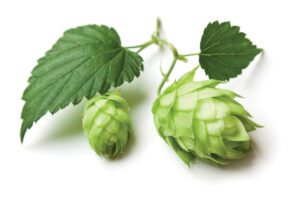
hops. Hops are the flowers of the Humulus lupulus plant and serve to balance
malt sweetness by adding bitterness, flavor, and aroma. They also act as natural preservatives due
to their bacteriostatic properties.
In our American Pale Ale example, hops provide the crisp bitterness and citrusy-piney aroma typical
of the style. The amount of hops you use depends on their variety, alpha acid percentage, and when
they’re added during the boil — all of which determine the beer’s
IBU (International Bitterness Units).
Hop suppliers provide specification sheets listing the Alpha Acid %, which shows the
bitterness potential of each variety. Explore these examples:
Correct Tinseth IBU Formula:
IBU = (AA_decimal × Ounces × 7462 × Utilization) ÷ Wort_Volume_gal
Where:
AA_decimal = Alpha Acid % ÷ 100
Utilization = fraction of alpha acids isomerized (0.05–0.30)
Example:
Using 1 oz Cascade @ 5.5% AA in 5 gallons with 25% utilization:
AA_decimal = 5.5 ÷ 100 = 0.055
IBU = (0.055 × 1 × 7462 × 0.25) ÷ 5
IBU = 20.5
If this formula feels complex, don’t worry — we’ll break it all down step by step. You might be wondering:
How do I choose hop varieties? What’s dry hopping? How does timing change flavor vs. bitterness?
Let’s explore.
The compounds in hops responsible for bitterness. When boiled,
alpha acids isomerize and contribute to IBUs.
International Bitterness Units measure the amount of isomerized
alpha acids, representing a beer’s bitterness level.
The percentage of alpha acids converted to bitterness during
boiling — influenced by time, gravity, and volume.
The Hop Utilization Factor increases with longer boil times — up to about 30 minutes,
then plateaus.
Tip: The same hop can produce completely different results depending on
when it’s added!
| Addition Time | Hop Variety | Amount (lbs) | Alpha Acid % | Purpose | Est. IBU |
|---|---|---|---|---|---|
| 60 min | Chinook | 2.5 | 12.0% | Bitterness | 26.65 |
| 30 min | Centennial | 1.5 | 10.0% | Flavor | 10.24 |
| 5 min | Cascade | 3.0 | 6.0% | Aroma | 3.19 |
| Total IBUs | 40.08 | ||||
Note: Adjust hop weights based on actual Alpha Acid %.
Consider dry hopping with 3–5 lbs of Cascade or Centennial for additional aroma.
Use the calculator below to estimate your beer’s bitterness based on hop type, alpha acid %, addition time, and wort gravity.
The longer the hops boil, the higher the utilization — until saturation.
Tip: High-gravity worts reduce utilization efficiency.
Experiment with hop amounts and times to see how they affect total IBUs.

We’ve reached the final ingredient — and luckily, it’s the easiest one to calculate!
You’ve likely heard the saying, “Brewers make wort — yeast makes beer.”
That’s no exaggeration. Yeast is the engine of fermentation, turning sugars into alcohol, carbonation, and flavor.
Today we’ll focus on one key concept: determining how much yeast to pitch.
There are two main yeast types used in brewing:
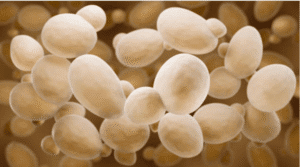
Saccharomyces cerevisiae (Ale yeast) and
Saccharomyces pastorianus (Lager yeast).
These yeasts differ in fermentation temperature, flavor contribution, and cell requirements (known as the pitch rate).
Lager yeast ferments at cooler temperatures, grows more slowly, and therefore requires a higher cell count than ale yeast.
Recommended Pitch Rates:
That’s a lot of yeast!
Bottom-fermenting yeast that thrives at 45–55°F. Produces clean, crisp beers with low ester production.
Top-fermenting yeast that prefers 60–72°F. Creates fruity and complex flavor profiles in ales.
The number of yeast cells added per mL of wort per °Plato. Correct pitching ensures a healthy fermentation.
For a 10 BBL batch of American Pale Ale with a starting gravity of 12° Plato
and an ale yeast pitch rate of 750,000 cells/mL/°P:
10 BBL = 310 gallons = 1,173,480 milliliters 1,173,480 mL × 12 °P × 750,000 cells = 10.6 trillion cells
✅ Result: You’ll need approximately 11 trillion cells for a healthy fermentation.
Tip: Pitching too little yeast can cause off-flavors and slow fermentation; too much can reduce ester character.
If the calculator doesn’t load,
click here to open it in a new tab.
Now it’s your turn to apply what you’ve learned! Using the BJCP style guidelines for a Hefeweizen, calculate and design a complete recipe for a 7 BBL batch.
You’ll need to determine:
Fill out the form below to submit your recipe for review.
Once submitted, your recipe will be reviewed for accuracy, style alignment, and proper calculation methods. Don’t forget to double-check your math before hitting submit!